
| Our Publications | ||
| Books by Title | ||
| Books by Author | ||
| Books by Country | ||
| E-books | ||
| About | ||
| Orchid Press E-books | ||
| Distributed E-books | ||
| Our Bookshop | ||
| About Us | ||
| Browse Shop | ||
| How to Buy | ||
| Contact Us | ||
| WE BUY BOOKS AND LIBRARIES | ||
|
||
Bibliotheca Himalayica
The purpose of Bibliotheca Himalayica is to make available works on the natural history and civilizations of Central Asia and the Himalaya. The selection of books includes new works by present day scholars as well as reprints of classical, out-of-print or antiquarian books. Reprints of older books may include additional contemporary illustrations as well as an up-to-date introduction.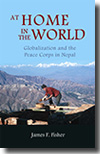 |
At Home in the World: Globalization and the Peace Corps in Nepal by James F. Fisher 2013, 218 pp., 21 b & w illustrations, endnotes, bibliography, index, 22 x 14 cm., softcover. ISBN-13: 978-974-524-157-2 $25.00 A detailed first-hand account—and critical analysis—of the impact of the first contingent of American Peace Corps volunteers to live and work in Nepal, arriving in 1962 just following the King’s seizure of absolute power and the tentative opening of the country to the outside world. The book not only explores the successes and failures of the volunteers in their efforts to have a positive effect on Nepalese development, but also the reverse effects of their transformative experience on the lives of the volunteers themselves. The narrative is further expanded as the author places the mission in the broader perspective of the globalization process that has so changed our world in the past 50 years. A richly rewarding account for all with interests in globalization, social change, and transnational anthropology. [Read a review from the Asian Highland Perspective] [Read a review from the Friends of Nepal] [Read a review from the The Kathmandu Post] [Read a review from the Peace Corps Volunteers] |
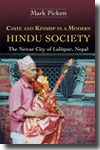 |
Caste and Kinship in a Modern Hindu Society: The Newar City of Lalitpur, Nepal by Mark Pickett 2014, 384 pp., 25 b & w images, 16 maps, 23 x 15 cm., softcover. ISBN-13: 978-974-524-136-7 $35.00 [Bibliotheca Himalayica Series III Vol. 18] This study comprises an in-depth examination of the anthropology of caste as observed in the Newar communities of the Kathmandu Valley, Nepal, and, by extension, within Hindu society more generally. Anthropologists have traditionally held that the phenomenon of caste in South Asia is the expression of a hierarchical system, ranking members in society on the basis of one or more characteristics, such as occupation, power or relative ritual purity. The present study argues that caste—and thus civic order—in Newar society derives from the antagonistic relationship between the forces of family lineage and the historic centrality of royal authority, the latter maintained to the present in annual festivals and by the use of urban space. In his study of four groups of artisans in the City of Lalitpur—collectively the Pengu Dah—Pickett demonstrates how this creative tension between kinship and kingship results in the institution of caste. An important contribution for academic and lay readers with interest in Hindu social structures and South Asian culture. [Read a review from HIMALAYA, the Journal of the Association for Nepal and Himalayan Studies] |
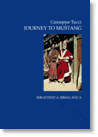 |
Journey to Mustang by Giuseppi Tucci 2nd English edition, 96 pp., 85 b&w plates, 22 x 14.5 cm., softcover. ISBN-10: 974-524-024-9 $29.00 ISBN-13: 978-974-524-024-7 In this new edition of his travalogue of an exploratory trek through western Nepal in 1952, the legendary linguist and Tibetologist, Guiseppi Tucci, describes his experiences and discoveries as the first 20th century western scholar to travel through the region. His account preserves an invaluable record of the art, culture, social and religious practices of the inhabitants of Mustang, prior to the inevitable changes that have since occurred, with the intrusion of the modern world and regional politics into this ancient land. |
 |
Three Years In Tibet by Ekai Kawaguchi 1909, 1979, 1995. xxi, 720 pp., 11 b&w photos (one fold-out), 63 woodcuts, one fold-out map, 22 x 14.5 cm., hardcover. ISBN-10: 974-524-014-1 $36.00 ISBN-13: 978-974-524-014-8 Reprint of the 1909 original, with a new introduction by H. K. Kuløy. Account of Kawaguchi’s now legendary solo trip, beginning 1899, through a Tibet long hostile to all outside visitors. Passing himself off at times as a Chinese doctor and at others as a native Tibetan, Kawaguchi managed to traverse practically the entire length of Tibet, largely on foot, reaching Lhasa in 1901—a feat of outstanding courage and endurance, not to mention much good fortune. But the real value of the account is found in the author’s careful and detailed observations of Tibet, Tibetans, and the rule of the 13th Dalai Lama, with whom he met a number of times. Kawaguchi was both awed by Tibetans’ religious discipline and shocked by the cruelty, corruption and sexual licence he saw around him. Overall, a fascinating account for all with interest in this complex society and how it functioned prior to the onslaught of foreign influence, both Chinese and Western, in the 20th century. |
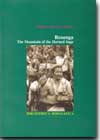 |
Resunga The Mountain of the Horned Sage by Philippe Ramirez (ed.) Translated from the French by Susan Keyes. 2000. x, 304 pp., 97 b&w pl., 36 figures and maps, bibliographies of new and ancient references, glossary of Nepali terms, 22.5 x 15.5 cm., softcover. ISBN-10: 974-524-017-6 $20.00 ISBN-13: 978-974-524-017-9 A multi-disciplinary study of Gulmi and Argha-Khanci, two districts in modern central Nepal which coincide with the boundaries of prominent earlier principalities, prior to the unification of the country in the late 18th century. The study, conducted by a team of French scholars in the early 1990s, traces the history, ecology, ethnology, social and political structure, economic activity and religious ritual of the region’s inhabitants. A fascinating and detailed account of part of Nepal which has subsequently become one of the most troubled in the country. |
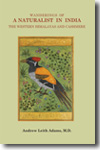 |
Wanderings of a Naturalist in India, the Western Himalayas and Cashmere by Andrew Leith Adams, MD Second imprint 2018 (first edition 1867). 223 pp., i-x, 1 ill., index, 22 x 15 cm., softbound ISBN-13: 978-974-524-113-8 $21.95 India is home to one of the richest and most diverse populations of wildlife of any territory on earth, including lions, multiple species of tigers and leopards, many species of deer, the Indian elephant, the rhinoceros and a great multitude of reptiles and birds. At the beginning of the British Raj (1858) Indian wildlife populations were largely intact—some estimate that there were up to 100,000 tigers in the territory alone. The following 100 years, however, saw this rich heritage greatly depleted. A swelling native population combined with the British colonial passion for big game hunting wreaked havoc on all Indian wildlife. By the mid 20th century the tiger population was reduced to less than 2,000 animals and a number of other important species had been driven to extinction. Indian and international efforts in the past several decades have attempted to arrest, if not reverse the damage and at present India hosts some 515 wildlife sanctuaries and 18 biosphere reserves. The present volume, aside from providing a fascinating historical travalogue, presents a sampling of what Indian wildlife consisted of in the mid 19th century, prior to the devastation that was to follow. As such it is a fascinating read for all with interest in the ecology and history of the Subcontinent. |
PO Box 70, Trinity TB, NL, A0C 2S0, Canada
Telephone: +1 709-330-4703