
| Our Publications | ||
| Books by Title | ||
| Books by Author | ||
| Books by Country | ||
| E-books | ||
| About | ||
| Orchid Press E-books | ||
| Distributed E-books | ||
| Our Bookshop | ||
| About Us | ||
| Browse Shop | ||
| How to Buy | ||
| Contact Us | ||
| WE BUY BOOKS AND LIBRARIES | ||
|
||
Book Reviews
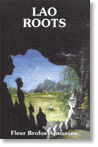
Lao Roots
byFleur Brofos Asmussen
1997. 260 pp., richly illustrated with 86 historical photographs, 21.5 X 15.2 cm., Softbound.
ISBN-10: 974-8299-27-9 $23.00
ISBN-13: 978-974-8299-27-3
Lao Roots
Book review by David Snellgrove
(Siam Society Journal, date unknown)
The motive and effective starting-point for this book occurs in 1950 when the author must have been about 22 years old. It was only then that her mother, Irene Louise Hauff Brofos, revealed to her three children the origins of her birth, namely that she was the natural child, born in 1901, of a Laotian woman named Sau Boun Mao, and had been fathered by their grandfather, Peter Hauff, an adventurous trader who had spent the active part of his life (from 1890 to 1928) in Indo-China, primarily in Saigon and Laos. Earlier in 1896 he had fathered another daughter, later known as “Maud Sofie Hauff”, by a Vietnamese woman named Chi-Thin. Fleur Brofos refers to this revelation as a “bombshell” and she becomes determined to discover all she can concerning her part-Laotian origins. Thus there develops a consuming interest in the life of her grandfather Peter Hauff, as now recorded in this book. She uses all available literary sources as well as such personal reminiscences as can be gleaned from the few survivors who had known him personally.
The book falls naturally into two parts. The first, Fleur’s story, which tells of many family events, including finally accounts of the eventual visits to Laos. The first was made by her sister Bambi and husband Serge Gabriel in 1967; this was followed by a brief visit by Fleur herself soon after Christmas 1969 accompanied by her sister, and finally a substantial visit in 1990 when Fleur was able to meet all her distant Laotian relatives. These are primarily the two daughters of her grandmother Sau Boun Mao who had long since passed away. Both are the offspring of her local marriage to a certain Thit Phoua and thus are half-sisters of Fleur’s mother. Sau Boun Mao married only after Peter Hauff’s visit to Norway in 1905, when he married a Scandinavian wife. Having returned to Saigon with his wife, he retrieved his two daughters from Laos, namely Fleur’s mother-to be, now named “Irene Louise Hauff” and her half-sister, now named “Maud Sofie Hauff”. From then on they were brought up as though they were the legitimate offspring of their father. This unusual “nuclear family” of four lived for a short while in Saigon where every effort was made to distance the two daughters from their Vietnamese and Laotian origins. The two girls were educated in Europe from 1908 onwards. Fleur questions in the book why her grandfather failed to bring his natural wife Sau Boun Mao back to Norway (instead of marrying a Scandinavian wife) although he subsequently brought the two girls, thus separating the newly named “Irene Louise” from her mother for ever. As just noted above, Sau Boun Mao married locally soon after his departure, and gave birth to the two daughters, who were subsequently heralded as Fleur’s nearest Lao relatives by this resolute young grand-daughter of his, viz, the author of this book. It is she who sets about restoring the links between the adventurous years of her grandfather’s youth and his later more settled life. The Scandinavian marriage, however, produced no offspring and does not appear to have been a very happy one. Peter Hauff never abandoned in his thoughts his first wife Sao Boun Ma. If this brief summary seems bewildering, one will realize how essential are the “family-trees” at the end of the book for following the full account.
There is an obvious conflict in Peter Hauff’s life between his ready adaptability to Asian ways of life and the constraints that were placed upon him by social prejudices in Europe at the beginning of the 20th century. His close relatives at home would have found it utterly unsuitable for him to marry formally a Laotian wife and bring her back to Norway, but it was considered suitable to bring the two daughters on the condition that they were educated and brought up as young European ladies. This had a profound psychological effect upon Fleur’s mother who concealed her real origins from her three children until 1950 when they were considered old enough to take the “shock”. This may have been a “bombshell”, but there was nothing socially scandalous for them in this matter. Fortunately ideas of racial relationships began to change during the course of the 20th century, especially after the 2nd World War. However, Fleur’s mother persisted in her aloofness from everyone and everything Laotian until the end of her days.
We now come to the second part of the book, certainly the most interesting one, entitled “Grandfather Peter Hauff’s story”. This is based upon a manuscript which Peter Hauff produced about the year 1930. In this he recorded the adventures, reminiscences and observations of his life in Indochina, producing three versions in Norwegian, English and French. In 1936 he tried to get it published in Norway with some such title as Mekhong: a Norwegian Trader’s experiences in Indochina, but it was rejected as concerning too remote a country to be of general interest. It is thus to the undoubted credit of Mr Hallward Kuloy of the Orchid Press to have agreed to publish this work now that it has been worked on by Fleur Brofos Asmussen. Apart from her grandfather’s manuscript, she includes other source-materials as well as many illustrations from old photographs which happily came to hand. Peter Hauff also maintained a very detailed diary of his daily doings, but regrettably this was burned by his wife, Fleur’s mother, immediately after his death. This diary surely included references to his relationships with local women in Indochina and thus to Fleur’s own birth. At the same time it must have contained much more of far greater interest and its destruction is much to be regretted. Peter Hauff was a remarkable man, who as trader and man of business, maintained an active and sympathetic interest in local life while seeing as much as he could of local places.
He was born in Norway in 1873, son of a much-travelled ship’s captain, and after serving a business apprenticeship in London at the age of 17 to 18, he sailed from Marseilles to Saigon in 1873/4. Here he found employment with a local trading company and rapidly adapted to local life. It is interesting to note that he found Malay (as throughout the Dutch East Indies of that period) the most useful language for his work rather than the local Annamese. He made a name for himself by provisioning some Russian naval ships which arrived in the harbour, for which he was paid in gold, the preferred currency of the times (and in fact still often used throughout Indochina). He built a small house for himself between Saigon and the nearby mainly Chinese trading city of Cho Lon. He had good relationships with the French (who by 1884 had established their authority over the whole of Vietnam and Cambodia) as well as with the Siamese (Thai) and Cambodian officials, with whom he made contact in the course of his trading ventures. These followed mainly the course of the Mekong River from its wide-spread delta in Vietnam for a thousand kilometres and more northwards to Laos. This river also serves as the boundary between Laos and Cambodia, and then further north as the boundary between Laos and Thailand. The route up the Mekong had been opened up by an exploratory French expedition lasting just over two years (5th June 1866 to 29th June 1868). The driving spirit of this extraordinary adventure was Francis Garnier, second in command, becoming the leader following upon the death of Commander Doudart de Lagrée at Hui-tse in Yunnan. For a succinct account see Milton Osborne, “Francis Garnier (1839-1873), Explorer of the Mekong River” in Explorers of South-east Asia, Six Lives, edited by V.T.King, OUP Kuala Lumpur 1995. This account, which records the great difficulties of ascending the Mekong, impossible to navigate in sections because of rapids and waterfalls, helps in placing the journeys of Peter Hauff in a fair perspective. On his first journey up the Mekong in April 1898, primarily to investigate the possibilities of trade, he reached as far as southern Laos. The steamer could only go as far as Kratie, whence the Sambor rapids had to be manoevred in small boats. At Stung Treng (still in eastern Cambodia) one transferred to a small steamer as far as Khone. Here the French had built a railway four miles long, capable of transporting two small steamers, in order to pass the very worst stretch of rapids. Thence a small steamer took one on to Kong, the chief settlement in South Laos. Peter Hauff travelled some further 100 miles up the river by the same type of transport to Don Co, an island seemingly near Pakxe as shown on present-day maps. From here he returned to Saigon, satisfied with this exploratory visit and determined to pioneer a trading venture to Laos. He found a partner in Hans Rudolf Feesch of Swiss nationality, and from here on the book contains excepts from the personal observations of his partner, interspersed with Peter Hauff’s running account. This adds even more local interest to Hauff’s second journey up the Mekong a year later, but variations in place-names make it rather more difficult to follow the text accurately. This is no fault of the author, as she can only reproduce place-names as found in her sources. Does Pak Moun (presumably French spelling for Mun with reference to the River Mun) corrrespond to Pakxe? Here Don Có of Hauff’s earlier account is just south of Pak Moun. This would seem to be so, for having completed their trading at this place they set out of a subsidiary trading venture up to Mun River (written Se Moun) to Ubon Ratchasima in Thailand, where they were received by the local Thai governor. After this side-excursion they continued up the Mekong to Ventiane, the capital of Laos, arriving there three and a half months after leaving Saigon. Here they built a house which become the centre of their subsequent trading throughout the whole area, the trading eventually extended as far north as Luang Prabang. Subsequently with help of his brother in London, Hauff designed a steamer suitable for travelling up the Mekong and with long delays this eventually reached Saigon in 1902.
However, the attempt to travel up the river with this vessel proved abortive. Unable to proceed beyond Khong he let it out to the French authorities and continued northwards by the normal means. From Pak Moun he made another visit to Ubon Ratchasima at the request of the French consul there, and on his return he found himself in the midst of the turmoil and destruction of property and life caused by the so-called “Holy Men’s Rebellion”. This started as a form of religious protest against the modernizing changes which were then taking place in Thailand as the result of contact with the outside world. However, like all such popular movements, it rapidly developed into an excuse for banditry and pillage. Hauff bravely continued his journey northwards to Ventiane, anxious for the safely of his colleague Feesch, who proved to be very ill, as well for their property at this their main base of operations. He found his colleague very ill indeed and their business affairs in a very bad way. Money paid out in advance for expected articles of trade was lost in the general chaos because many of their sub-contractors had either fled or been killed. As an unexpected but welcome form of compensation, he received an order from a firm in Saigon to deal with a large supply of teak timber which had been bought from the Second King of Luang Prabang. This had to be floated down the Mekong from Luang Prabang to Saigon. This was an enormous task, accomplished by heroic determination, and a whole chapter is devoted to this particular exploit. Presumably it assisted him financially when so much else was lost. In the midst of this operation he learned that Feesch had died in Ventiane and all their property there had been auctioned off. This effectively put an end to the trading ventures in Laos. Hauff returned to Norway and married, as already related above. When he later settled in Saigon as director of a tile and mosaic factory, there was little scope for more adventure. Thus his manuscript, as quoted in this book, concerns mainly the years 1894 to 1905.
Apart from detailed accounts of journeys up and down the Mekong, this manuscript contains interesting descriptions of local conditions, of customs and festivals as well as of the practice of Buddhism in Laos. He was a remarkable man, loyal in his personal relationships, resolute and brave, often seeking adventure for its own sake, such as his witnessing the bombardment of Santa Barbara during the Spanish-American war in the Philippines. This happened at the mere suggestion of a friend who was taking a load of rice to the island of Panay. At the same time his profound religious sensibility, more Buddhist than Christian, is evident. He visited the great Lao-style Buddhist shrine at Nakhon Phanom, one of the most sacred places in Thailand, noting various legends as well as its dilapidated condition (p.168). In fact it collapsed in 1975 but was soon restored to its now resplendent condition by the Fine Arts Department of the Thai Government. For mere interest he went to neighbouring Cambodia, already a French protectorate since 1863, and gives succinct accounts of his visits to Phnom Penh and to Angkor (Siem Reap). One might well envy the possibility of such a visit to Angkor Vat and Angkor Thom in the early 20th century, when the French authorities were beginning to interest themselves in their conservation and long before they suffered the depredations of later times (especially the period 1970 to almost the present day). He made four visits there in 1911, 1919, 1928 and 1929. He speaks well of the Cambodians whom he preferred to the Vietnamese. The tranquillity of Angkor Vat and the part-ruined temples of Angkor Thom, where no trading interests were involved, seem to have exercized a permanent attraction upon Peter Hauff. He made his fourth and last visit there just before returning finally to Europe in 1929. Here he settled eventually in the south of France, in due course enduring like so many others the dangers and privations of the German occupation during the war years of 1940-45. He died, much impoverished as the result of the war, in France in 1951.
As an overall criticism of this book, so skilfully compiled by his granddaughter, I note that the title of the book Lao Roots seems to apply mainly to her subsequent efforts to find her Laotian relatives. Interesting as this may be, it represents the lesser part of the book. There should have been at least a sub-title such as My grandfather’s life in Indochina or even as Peter Hauff himself wished, namely A Norwegian Trader’s Experiences in Indochina. The reviewer would certainly have preferred this as the main title.
[More Orchid Press Reviews]
PO Box 70, Trinity TB, NL, A0C 2S0, Canada
Telephone: +1 709-330-4703