
| Our Publications | ||
| Books by Title | ||
| Books by Author | ||
| Books by Country | ||
| E-books | ||
| About | ||
| Orchid Press E-books | ||
| Distributed E-books | ||
| Our Bookshop | ||
| About Us | ||
| Browse Shop | ||
| How to Buy | ||
| Contact Us | ||
| WE BUY BOOKS AND LIBRARIES | ||
|
||
Book Reviews
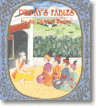
Pilpay’s Fables
by Sir Richard Burton
with an introduction byTom Cox
2003. 96 pp., 9 colour plates. 21 x 19 cm. Hardbound.
ISBN-10: 974-524-028-1 $27.95
ISBN-13: 978-974-524-028-5
Lessons in Life
South China Morning Post: ‘BOOKS – THE REVIEW’. Sunday August 17th, 2003
Explorer Sir Richard Burton’s earliest translation has been published for the first time, thanks to an ethnographer and Hong Kong’s Orchid Press.
Ethnographer Tom Cox’s complicated passion for Sir Richard Burton became even thornier when he discovered that the earliest translation by the politically incorrect explorer and spy was still unpublished.
Burton’s version of the ancient Indian stories known as Pilpay’s Fables would make a great children’s book, Cox figured.
Publishing the book also offered him the chance to write an adult introduction hitting out at modem anthropologists who scorn Burton’s 19-century studies of sensitive cultural practices, particularly sexual and religious customs.
When Cox, 42, went undercover to study Nepal’s sex industry he adapted the tactics of Burton, who introduced the Kama Sutra to the west and disguised himself while infiltrating Karachi’s homosexual brothels.
But the academic and consultant for Pfizer—maker of Viagra—struggled to find a publisher willing to release a children’s book by an explorer often accused of racism. Some publishers wanted to make his book drily academic. Others “wanted to water it down into an artsy, barren, coffee-table book”.
Cox found his answer at Orchid Press, based in Hong Kong and Bangkok. “Orchid gave it the right balance of art, ethnography and scholarly value that would be accessible to the public,” he says. “I wanted a book that would appeal to children and people who are interested in Oriental literature and the old-fashioned ethnography Burton practised.
“Burton in himself is a huge industry. He’s the ultimate macho, scholarly hero to thousands all over the English-speaking world. We’re hoping to appeal to fans of Burton the macho man.”
Cox found his chance to be a part of the explorer’s legacy in 1995 while reading Fawn Brodie’s biography of Burton for the second time. A footnote mentioned that Burton’s first translation, of Pilpay’s Fables, had yet to be published.
Cox tracked the 1847 translation to California’s Huntington Library. Within a few days he had a copy, his closest contact with the father of ethnography. “I was utterly thunderstruck,” Cox says. “I was just floored with the realisation of what a great opportunity had fallen into my lap. I have to admit that I idolise Burton. Professionally arid personally he is one of my greatest heroes.”
Expelled from Oxford University for attending horse races, Burton joined the army of the East India Company at 21 as an intelligence officer posted to the Sindh, now part of Pakistan. Burton’s travels made him fluent in 24 languages, Cox says. Include dialects and the number is 40.
Burton often used disguise to “go native”. For days he pretended to be a shopkeeper in the Karachi bazaar and risked death by dressing as a Muslim to observe Mecca.
When Burton died in Trieste in 1890, his wife tried to distort the truth of his less-than-Victorian life by burning his diaries and manuscripts.
The translation of Pilpay’s Fables survived the fire, the flooding of a library and second world war bombings before being forgotten.
The fables have been traced to the Panchatantra, an Indian text thought to have been written in 200 BC. The ideas probably existed long before in oral tradition.
Burton was 26 and already fluent in Hindi, Persian and Sanskrit when he translated Pilpay’s Fables. His work is special because linguistic and ethnographic skills allowed him to pick subtle meanings and tones to detect where Hindu themes were buried when the fables were translated from Sanskrit into Persian.
“One part of the fables had a man identified as a Hindu, but his characteristics were clearly Muslim,” Cox says. “Burton concluded that the Muslim translator didn’t want to have a story about a Muslim man taking his wife to meet another man. The Muslim storyteller made the dupe of the story Hindu.”
The fables tell of animals or people overcoming misfortune, with each offering a life lesson and a moral. Cox admits that some of Burton’s work was racist, but he uses his introduction to the ethnographer’s fables to urge the study of Burton’s work, panning contemporary American anthropologists as too theoretical.
“They don’t write the richly detailed, empirical, ethnographically authoritative accounts that Burton did because, quite simply, most of them can’t,” the introduction says.
“If they officially recognise Burton’s work they will, implicitly, be showing the world just how inadequate and misguided their own work is. They want to preserve the mystique, the myth, that real, professional-level anthropology can only be done by Ph.D-holding academics.”
Alister McMillan
[Read a review from The National Centre for Performing Arts in Mumbai, India] [More Orchid Press Reviews]
PO Box 70, Trinity TB, NL, A0C 2S0, Canada
Telephone: +1 709-330-4703